

Last Updated: October 25, 2026
Quick Summary
To organize small spaces, measure your rooms and doorways first, sort belongings into keep, donate, and toss, then map storage to each zone before buying anything. Use vertical storage, hidden furniture storage, and multi-purpose pieces to add capacity without losing floor space, and reset the space every week.
- Measure wall length, height, and doorway and stair width before buying any storage piece.
- Sort one zone per evening into keep, donate, and toss piles before buying containers.
- Wall hooks are the cheapest vertical storage and keep bags and keys off counters.
- Fix every tall shelf and bookcase to the wall with an anti-tip bracket.
- Spend first on wall hooks and a coat rack, and buy decor last.
Table of Contents
- Start With a Plan: The Five-Step Process to Organize Small Spaces
- Step 1: Measure Before You Buy
- Step 2: Sort, Then Store
- Decluttering Tips for Small Spaces That Actually Stick
- Small Space Organization Ideas That Use the Walls
- Small Space Storage Ideas: Furniture That Hides the Clutter
- Small Bedroom Organization for Rooms With One Closet
- Safety, Access and Weight Limits Before You Load a Shelf
- Budget Tiers: What to Buy First, Second and Last
- Shop the Storage Pieces That Fit Your Measurements
- Frequently Asked Questions
Start With a Plan: The Five-Step Process to Organize Small Spaces
Learning how to organize small spaces starts with a plan, not a shopping trip. Small-space organization is the practice of using vertical space, hidden storage, and multi-purpose furniture to fit more into fewer square metres.
Here is the order that works:
- Measure your rooms and doorways
- Sort your belongings into keep, donate, and toss
- Map storage to each zone
- Buy only what fits your measurements
- Reset the space every week
That last step matters more than any shelf you buy. The 5 steps we cover here build on each other, so skipping one usually means buying the wrong thing twice.
Step 1: Measure Before You Buy
Measure first, buy second. This one rule prevents most returns and most clutter. Grab a tape measure and note four numbers for every wall: length, height, and the width of each doorway and stairwell.
Most people forget the doorway. A shelf that fits the wall may not fit through the door.
Write down these figures in a notebook:
- Wall length and height, in metres
- Doorway and stair width
- Distance from the floor to any light switch
Take the notebook shopping. The NHS guidance on preventing falls at home makes a related point: clear walkways and safe access matter as much as storage.
Step 2: Sort, Then Store
Sorting comes before storage. Pull everything out of one zone at a time and make three piles: keep, donate, toss. Be honest about the keep pile.
A common mistake is buying containers to hold things you should have donated. Storage containers do not fix clutter. They just hide it.
Work one zone per evening:
- Entryway: coats, bags, shoes
- Living room: media, books, cables
- Bedroom: clothes, linens, small items
When you finish a zone, put back only the keep pile. Then measure what is left.
Decluttering Tips for Small Spaces That Actually Stick
Decluttering tips for small spaces only work if they survive contact with a normal week. The trick is a one-in, one-out rule plus a five-minute daily reset.
Try these habits:
- Keep a donation bag by the door
- Clear one surface every night
- Store like with like, not wherever a gap appears
Minimalism is not about owning nothing. It is about owning what you use. Scale down slowly, and the space stays clear.
Small Space Organization Ideas That Use the Walls
Walls are the most overlooked storage in any small apartment. Vertical storage turns empty wall space into usable room without taking up floor space, and it is the single highest-leverage move in most small homes. The trick is matching the wall system to your layout and your daily routine, not just buying hooks.
Match the wall system to your layout
Different small spaces need different wall strategies. Use this quick comparison to pick your starting point:
| Layout | Best wall approach | Why it works | Watch out for |
|---|---|---|---|
| Studio | One tall wall unit plus a rail system over the desk | Concentrates storage on one wall so the rest of the room stays open | Do not block the only window wall |
| Shared room | Individual wall zones per person (hooks, shelf, basket) | Gives each person a defined spot so items do not migrate | Keep zones at each person's reach height |
| Rental | Tension rods, over-door racks, adhesive hooks | No drilling, removable at move-out | Check weight ratings on adhesive products |
| Narrow or oddly shaped room | Corner shelves and a vertical rail in the dead corner | Uses the corner no furniture can fill | Leave at least a doorway-width walkway |
| Family home | High shelves for adults, low hooks for kids | Keeps dangerous or fragile items out of reach | Anchor every tall unit to the wall |
Start with hooks and rails
Wall hooks are the cheapest vertical storage you can buy. A cap holder mounts on the wall to corral hats without using shelf or floor space. A corner coat rack fits snugly into a tight entryway and keeps coats off chairs.

Place hooks by function, not by decoration: entry hooks at shoulder height for bags and keys, a lower hook for the dog leash, and a high hook for guest coats.
Then add shelving with a purpose
Staggered shelves break up a wall and hold books, plants, and baskets. Keep the top shelf for items you rarely touch. Keep the middle shelf at eye level for daily items. That keeps things accessible without a step stool. A common pattern is to reserve the bottom 30-45 cm of a wall for furniture clearance and build storage upward from there.
Use the dead corners and the space above doors
Corners and the strip above a door are the two wall zones most people ignore. A corner shelf unit turns a dead corner into usable storage, and a shelf above the door holds out-of-season items or spare linens. Keep the above-door shelf for light, rarely used items, it is the hardest spot to reach.
Small Space Storage Ideas: Furniture That Hides the Clutter
Furniture with built-in storage is the quiet hero of small-space living. Hidden storage lets a room do two jobs at once.
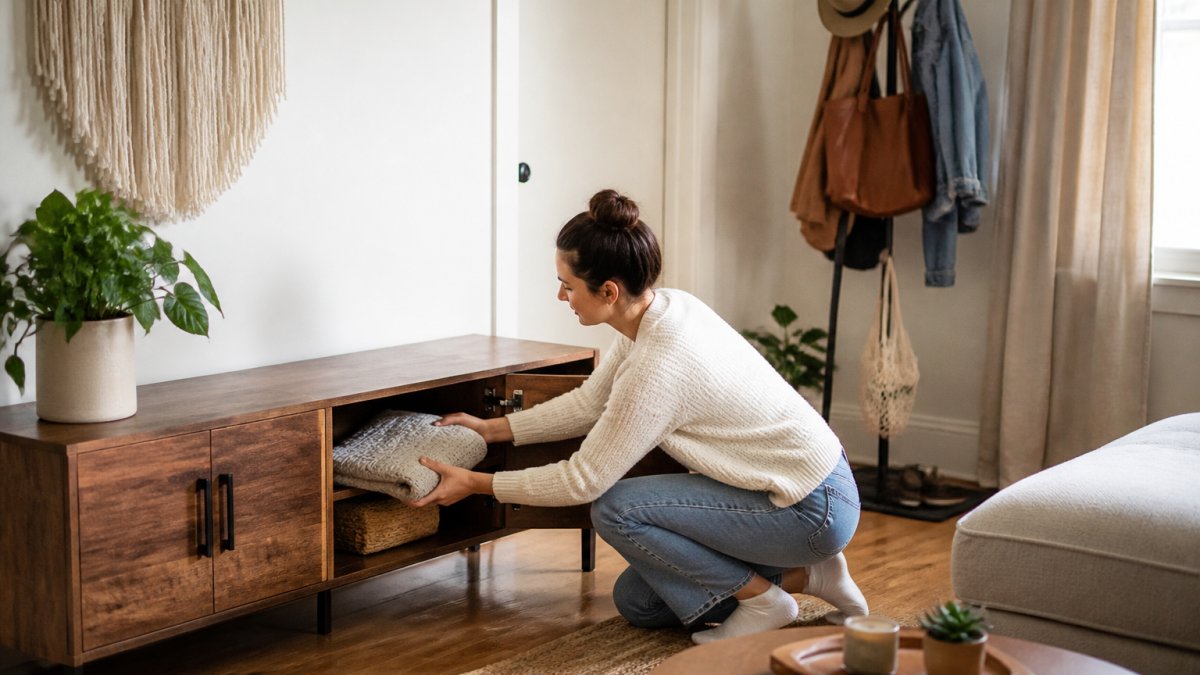
A TV console with storage cabinet holds media equipment, books, and cables behind closed doors. The surface stays clear, and the room feels larger.

Multi-purpose furniture earns its place:
- An ottoman that opens for blankets
- A hideaway desk that folds flat
- A bench with storage under the seat
Each piece replaces two items with one. That is how you add incremental storage without adding floor space.
Small Bedroom Organization for Rooms With One Closet
A small bedroom with one closet needs three storage layers: the closet, under the bed, and the walls. Small bedroom organization works best when each layer has a clear job, and when you plan the layers in order rather than buying bins at random.
Layer 1: Give the closet a system
A single closet fails when it is one undivided hanging rod. Divide it into three vertical zones:
- Top shelf (above eye level): out-of-season clothes, spare linens, luggage. Use labeled bins so nothing becomes a mystery box.
- Eye level: daily clothes on hangers, with a second short rod below for shirts or skirts if your closet is tall enough.
- Floor: shoes on a low rack or in clear boxes, plus a basket for laundry.
A common pattern is to add a shelf-and-rod insert so one closet does the work of two. Measure the closet's inside width, depth, and height before buying any insert, a system that is 2 cm too wide will not fit, and most are not adjustable.
Layer 2: Use under-bed storage properly
Under-bed storage is the largest hidden volume in most small bedrooms. Flat boxes on wheels slide out easily and hold linens or off-season clothes. Keep items accessible, not buried: store the things you need least often at the back, and keep a clear gap at the front so you can pull boxes out without moving furniture.
Measure the clearance from the floor to the bed frame before buying boxes. Standard under-bed boxes are often 15-18 cm tall, so a low frame may only fit flat zip bags rather than rigid boxes.
Layer 3: Use the walls and the door
The wall above the bed and the back of the bedroom door are two free storage zones. A shelf above the headboard holds books and a lamp, and an over-door rack holds robes, bags, or shoes. Keep daily items between knee and shoulder height so they are easy to reach without stretching or climbing.
Adapt the plan to your household
- Shared room: give each person their own wall zone and their own labeled bins, and use a twin over pull-out bunk bed to add sleeping space while using the vertical height a single bed wastes.
- Rental: choose tension rods, over-door racks, and freestanding closet inserts that come out at move-out.
- Tight budget: a budget furnishing guide helps you decide what to buy first, usually closet dividers and under-bed bags before any new furniture.
Safety, Access and Weight Limits Before You Load a Shelf
Safety comes before style. A loaded shelf that pulls out of a wall is worse than an empty one.

Check these before you load anything:
- Fix tall shelves and bookcases to the wall
- Put heavy items on low shelves
- Keep a step stool within reach for high shelves
Watch out: overloading a high shelf is the most common small-space mistake. It is also the one most likely to cause an injury.
Keep daily items between knee and shoulder height. That range is easy to reach without stretching or climbing.
Budget Tiers: What to Buy First, Second and Last
Spend in order of impact. The first money should go to storage you will use every day, not to decor.
| Tier | Buy This | Why It Comes Here | Example |
|---|---|---|---|
| First | Wall hooks and a coat rack | Cheapest way to free floor space | Corner coat rack |
| Second | Under-bed boxes and one shelving unit | Adds hidden storage without new furniture | Flat wheeled boxes |
| Third | Multi-purpose furniture | Highest cost, biggest long-term gain | TV console with cabinet |
| Last | Decor and extras | Only after storage works | Mirrors, trays |
A mirror is a smart last buy. It bounces light and helps a room feel larger. A serving tray corrals small items on a surface so they stay tidy.
Shop the Storage Pieces That Fit Your Measurements
Shopping is the final step, not the first. Bring your measurements and buy only pieces that match them. That single habit keeps your space clear and your budget intact.
Old Wells Trading Post curates modern, minimalist home decor at accessible prices, with discounts up to 50% on select items. We opened in 2024, so we keep the selection tight and simple to browse.
Frequently Asked Questions
How do you organize a small room when there is almost no floor space?
Move storage upward and into corners. Wall hooks, staggered shelves and a corner rack hold coats, bags and accessories without taking up floor space. Choose furniture with exposed legs so the floor stays visible, and pick pieces with built-in storage, such as a TV console with a cabinet, so one item does two jobs. Measure the wall and the corner first, then buy only what fits those numbers. Keeping surfaces clear is what makes a small room read as organized rather than crowded.
What is the 5-5-5 rule for decluttering?
The 5-5-5 rule asks you to sort a space in three passes: find five items to throw away, five to donate and five to return to their proper place. It works well in small spaces because it sets a short, finishable task instead of an all-day clear-out. Run one pass per drawer, shelf or surface. Repeat it weekly and clutter stops rebuilding. Pair it with a container for donations kept by the door so the bag leaves when you do.
What storage solutions work best in a small bedroom?
Start under the bed, which is often the largest unused volume in the room. Use lidded containers for off-season clothing and spare linens. Add a tall, narrow shelf in the corner rather than a wide low one, and use over-door hooks for robes and bags. If the room is shared, a bunk bed with a trundle adds sleeping space without adding footprint. Keep the top of the dresser clear and store jewelry and small items in a tray inside a drawer.
How do I keep a small space from getting cluttered again?
Give every item a fixed home and reset surfaces daily. A five-minute evening reset, where you return shoes, mail and cups to their places, prevents the pile from forming. Keep one small container for incoming paper and empty it weekly. Before buying any new storage piece, measure the gap it will fill and confirm the weight it can hold. Maintenance is cheaper than another round of decluttering, and it keeps the room feeling larger.
Your small space can hold more than you think, but only if you measure first and buy second. Old Wells Trading Post offers a curated range of minimalist storage and furniture, including wall hooks, hidden-storage consoles, and space-saving beds, all at accessible prices. Get started with Old Wells Trading Post and turn your cramped rooms into a calm, organized home.
