

Last Updated: October 26, 2026
Quick Summary
The best minimalist furniture for small apartments combines clean lines, neutral colors, material honesty and function per square metre with a footprint that respects your floor space. Measure the wall, doorway and walking path before buying, and favor multifunctional, closed-storage pieces that earn their footprint.
- Keep a 90 cm minimum clear main walking path and 40-45 cm between sofa and coffee table.
- Buy multifunction only when the primary function is genuinely good on its own.
- Choose modular when your layout will change within two to three years.
- Go vertical before outward: tall bookcases and floating shelves keep the floor clear.
- Spend most on seating, beds and dining surfaces; save on shelving and side tables.
Table of Contents
- What Counts as Minimalist Furniture for Small Apartments
- Space-Saving Furniture for Small Apartments: Measure First, Buy Second
- Multifunctional Furniture for Small Spaces: When One Piece Does Two Jobs
- Small Apartment Sofa Ideas: Seating That Fits the Room
- Modular Furniture for Small Apartments: Pieces That Adapt
- Storage That Conceals Clutter: Vertical Shelves, Ottomans and Corner Racks
- Price, Material and Durability: A Buying Framework for a Whole Apartment
- Building Your Minimalist Apartment Piece by Piece
- Frequently Asked Questions
What Counts as Minimalist Furniture for Small Apartments
Minimalist furniture is not simply small furniture. It is furniture designed with nothing extra: clean lines, no ornamental trim, a limited palette, and one clear purpose.
A tiny ornate side table is small, but not minimalist.
Small apartments punish visual clutter faster than large ones: every unnecessary curve, pattern, and handle competes for attention.
Four traits separate true minimalist furniture from furniture that merely measures small:
- Silhouette: straight or gently rounded edges, no carving, no exposed hardware beyond what function requires
- Color: neutral tones, or one deliberate accent repeated across pieces
- Material honesty: solid wood, plain veneer, or matte finishes that show what they are
Fail two of those four tests and a piece will look out of place next to genuinely minimalist furniture, however compact.
Space-Saving Furniture for Small Apartments: Measure First, Buy Second
The most common small-apartment mistake is buying before measuring. A sofa that looks compact online can swallow a living room once you account for walking space around it.
Measure three things before any purchase: the wall or corner the piece will occupy, the doorway and stairwell it must pass through, and the clear path you need to keep open. That third measurement decides whether a room feels livable.
Clearance and Circulation Rules That Decide the Layout
Circulation is the space you need to move through a room without turning sideways. These clearance rules hold up well in apartments:
| Zone | Clear space to keep | Why it matters |
|---|---|---|
| Main walking path | 90 cm minimum | Two people can pass, doors swing freely |
| Between sofa and coffee table | 40-45 cm | Legs and knees clear the table edge |
| In front of a wardrobe or cabinet | 70-90 cm | Doors and drawers open fully |
| Beside a bed | 60 cm on the access side | Getting in and out without a shuffle |
| Dining chair pull-out | 75 cm behind the chair | Sitting down and standing up cleanly |
Write these numbers on your measurements. If a piece leaves less than the minimum, it is the wrong piece, whatever the listing says.
Multifunctional Furniture for Small Spaces: When One Piece Does Two Jobs
Multifunctional furniture is the highest-use purchase in a small apartment: one piece that stores and seats, or seats and sleeps, replaces two pieces and frees the floor space both would have taken.
The trap is buying multifunction for its own sake. A rattling lift-top coffee table or a sofa bed whose mattress you feel through the cushion costs comfort every day to solve a problem you have twice a year.
A TV console with integrated storage is the clearest example of multifunction done right. The TV Console With Storage Cabinet gives you a flat surface for the screen and closed compartments for consoles, remotes, and cables, so the entertainment wall stays visually quiet, one clean line replacing a console plus a shelf plus a basket stack.

Small Apartment Sofa Ideas: Seating That Fits the Room
A compact two-seat sofa anchors most small living rooms, with a loveseat or quality bean bag as the alternative when the room is tighter. Choose the seat to the room, not to your ideal future apartment.
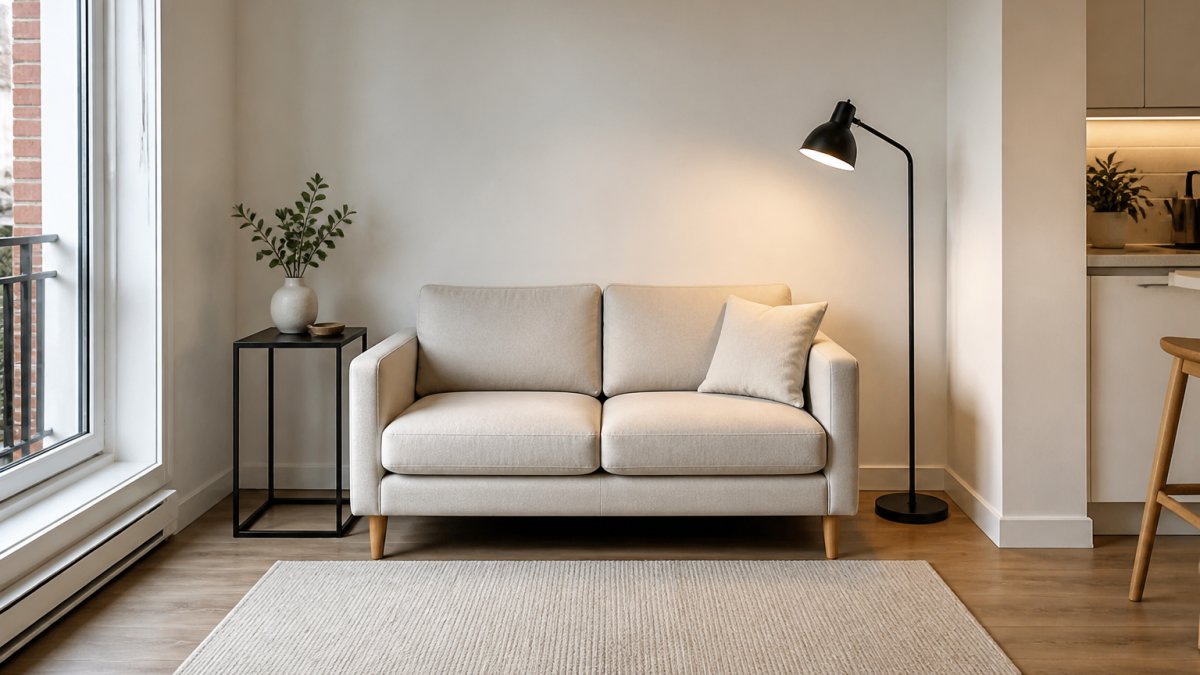
Measure the wall first, then subtract the clearance you need at each end. A sofa pressed into a corner on both sides looks cramped even when it fits.
Compact Sofa, Loveseat or Bean Bag: Matching the Seat to the Room
Three seating types cover nearly every small apartment:
- Compact sofa: best when you have one clear wall of two metres or more and want the room to read as a proper living space.
- Loveseat: best for narrow rooms or studio layouts where a full sofa would block the walking path.
- Bean bag: best for rooms with no spare wall at all, or as a second seat you move out of the way.
The Soft Bean Bag Chair fits the third case well. Its lightweight design lets you shift it between rooms, and the plush filling molds to your body for lounging, reading, or watching TV. Best for: studios and rooms where fixed seating would eat the floor. Skip if: you need firm back support for long sitting sessions.

Modular Furniture for Small Apartments: Pieces That Adapt
Modular furniture is built from separate units you can rearrange, stack, or extend as your space or needs change.
The practical test: does the system survive a move to a smaller room, a second occupant, and the replacement of one damaged unit? If any forces you to buy a whole new set, it is adaptable in name only.
What to Check Before You Buy a Modular System
Modular furniture fails in small apartments for predictable reasons. Check these first:
- Standard dimensions: Look for unit widths and depths that repeat across the range, so a new shelf or cabinet matches the old one years later. Common modular shelving widths cluster around 30 cm, 40 cm, and 60 cm; confirm the exact figures on the product page rather than assuming.
- Replaceable hardware: Connectors, brackets, shelf pins, and cam locks should be sold separately or be standard sizes you can source locally. A modular system is only as adaptable as its hardware.
- Flat-pack assembly: Most modular furniture ships flat. Keep the manual and spare fittings in one labelled bag; losing a single proprietary connector can make a whole unit unusable.
Modular vs. Fixed: When Each Wins
Modular is not right for every small apartment. A fixed, well-proportioned piece often looks calmer and uses space more efficiently because it has no gaps between units.
A common pattern: a modular low shelf starts as a TV stand, gains a second unit as a sideboard, and later becomes a hallway console after a move. That reuse is the real argument for modular, carrying the same pieces through several apartments.
A Minimalist Filter for Modular Pieces
Apply the same four minimalist tests, silhouette, color, material honesty, and function per square metre, to each modular unit, not just the set. A system with exposed metal brackets, mixed finishes, or decorative cutouts reads as busy even when the units are small. The strongest minimalist modular pieces share a flat front, a single material family, and disappearing hardware.
Storage That Conceals Clutter: Vertical Shelves, Ottomans and Corner Racks
Concealed storage beats open storage in a small apartment: every visible object adds visual weight, and closed doors and lids remove it instantly. But storage should also hide clutter without adding visual noise of its own. A cabinet with ornate handles or mismatched baskets can conceal the contents and still make the room feel cluttered.
The Minimalist Storage Test
Before buying any storage piece, run it through four questions:
- Does it close? Doors, lids, and drawers hide contents; open shelves display them. In a small apartment, favor closed storage for the bulk of your belongings and reserve open shelving for a small, deliberately styled selection.
- Does it read as one shape? A storage piece should look like a single volume, not a collection of boxes. Flat fronts, consistent gaps between doors, and handles that sit flush all help.
- Does it use height you already pay for? Vertical storage uses wall height rather than floor area. A tall bookcase or a run of floating shelves keeps the floor clear for circulation.
Vertical Storage: Shelves and Tall Bookcases
Go vertical before you go outward. A tall bookshelf or run of floating shelves uses wall height you already pay for and keeps the floor clear. For a deeper walkthrough, see how to organize small spaces without losing floor space.
Two constraints decide whether vertical storage works. First, ceiling height: a bookcase that stops well short of the ceiling leaves a dust-collecting gap and looks unfinished; one that reaches close to the ceiling reads as built-in. Second, wall construction: floating shelves need solid fixing points, studs or heavy-duty toggle anchors rated for the loaded weight.
Corner Racks and Entryway Storage
Corners are the most wasted space in any apartment. A Corner Coat Rack turns an awkward entryway or hallway angle into storage for coats, bags, and umbrellas, with a compact footprint that fits where a traditional rack will not. Best for: entryways and hallways too narrow for a freestanding rack. Skip if: you need to hang heavy items on a single hook for long periods.

Pair a corner rack with closed storage nearby, a slim shoe cabinet or storage bench, so the visible coats are the only things on display, keeping the entryway one calm zone.
Ottomans and Storage Benches
Ottomans and storage benches handle the living room the same way: a seat on top, a lid on the bottom, clutter gone. The White Bench Solid Wood Pine combines a backrest with a box compartment underneath, so it seats and stores in one footprint.
Two buying details matter more than the look. First, lid mechanism: a hinged lid that stays open on its own beats one you hold up while loading. Second, internal depth: a bench 40 cm deep externally may offer only 30 cm of usable space once the frame and cushion are accounted for.
A Storage Plan for a Small Apartment
Rather than buying storage piece by piece, map your belongings to four zones: entry, living, sleep, and utility. For each, decide what must be closed, what can be open, and what should not be stored there at all. A common minimalist pattern is closed storage at floor level, open shelving above eye level for a small curated display, and nothing on the floor itself, the strongest signal of a minimalist small apartment.
Price, Material and Durability: A Buying Framework for a Whole Apartment
Spend your budget where your body meets the furniture.
Material choice drives durability more than price. Solid pine and other solid woods hold up and can be refinished.
Maintenance is part of the cost. Solid wood needs occasional oil or wax; veneer needs a dry cloth and no standing water; fabric seating needs a vacuum and a matching spot cleaner.
Budget Tiers and What Each One Buys
Think in tiers rather than individual prices, and buy the anchor pieces first. For a full plan across an entire apartment, our guide to furnishing an apartment on a budget walks through the sequence.
| Tier | What it covers | Where to spend | Where to save |
|---|---|---|---|
| Entry level | Entry storage, side tables, decor | Nothing yet | Coat racks, small shelves, soft furnishings |
| Mid tier | Living room seating, storage bench, desk | Sofa or bean bag | Shelving, side tables, lamps |
| Anchor tier | Bed, dining table, main sofa | Bed frame, mattress, dining surface | Everything else |
A practical sequence for most first apartments: entry storage and a coat rack first, then seating, then the bed, then the dining table last. Each purchase should solve a problem you actually have today.
Building Your Minimalist Apartment Piece by Piece
The best minimalist furniture for small apartments survives the measure-first test, does at least one job well, and looks quiet next to everything else you own.
Start with your measurements and clearance numbers, then buy the piece that solves your most pressing daily problem, and let the rest of the room stay empty until you know what it needs.
Furnishing a small apartment on a tight budget usually means choosing between pieces that look right and pieces that hold up.
Frequently Asked Questions
What furniture is best for a small apartment?
Pieces that earn their floor space: a compact sofa or loveseat, a lift-top or storage coffee table, a wall-mounted or fold-down desk, and vertical storage such as a bookshelf or floating shelves. Measure the room and the doorways before ordering, and leave at least 60 cm of walking clearance around each piece. Fewer, better-chosen items will make a small apartment feel calmer than a room filled with small gadgets.
How do you furnish a small apartment in a minimalist style?
Start with a neutral base and one accent, then add furniture one piece at a time. Minimalist furniture is defined by clean lines, a low visual profile and a single job done well, not just by being small. Choose pieces with hidden storage so clutter stays out of sight, keep surfaces mostly clear, and repeat the same material or finish across the room so the layout reads as one scheme rather than a collection of odds and ends.
Is modular furniture a good choice for small apartments?
Yes, when you plan to stay a while or move between apartments. Modular furniture for small apartments lets you add, remove or rearrange sections as your layout changes, so a piece bought for a studio can still work in a one-bedroom. The trade-off is usually a higher upfront cost and more assembly. Check the footprint of the fully assembled configuration, not just the base unit, before you commit.
What is the best sofa for a small apartment?
A compact sofa or loveseat around 1.5 to 1.8 metres wide suits most small living rooms, with slim arms and legs that keep the floor visible. If the room doubles as a guest bedroom, a sofa bed earns its space. For a reading corner or a flexible second seat, a lightweight chair you can move between rooms works well. Measure the delivery route as carefully as the wall it will sit against.
How can I make a small apartment feel less cluttered?
Give every item a home you can reach without moving anything else. Use vertical storage such as tall bookshelves and floating shelves, tuck small items into a storage ottoman or a box bench, and put a corner coat rack by the door so bags and coats stop landing on chairs. Keep one surface per room clear, choose furniture with concealed compartments, and remove one item for every new one you bring in.
